

Wednesday, October 30, 2013
When does heresy become heresy?


Wednesday, October 23, 2013
We know now there is nothing left to fear

Sinclair Ferguson's sermon 'Can I fully trust you?' on the 23rd Psalm can be found here
It repays careful listening.
Monday, October 21, 2013
The cross has little place in your preaching

Iain Murray recounts a fascinating criticism made of Lloyd-Jones' preaching in the late 1920s. It was made by a fellow minister when Lloyd-Jones was preaching at a service in Bridgend, South Wales. Here's the substance of what the Bridgend minister said:
'...you talk of God's action and God's sovereignty like a hyper-Calvinist, and of spiritual experience like a Quaker, but the cross and the work of Christ have little place in your preaching.'D. Martyn Lloyd-Jones: The First Forty Years 1899-1939, p. 190-191 (emphasis added)
The observation it seems was true.
Lloyd-Jones, speaking at a later date (Murray doesn't indicate when), spoke of how he was like George Whitefield in his early evangelistic preaching, strongly emphasising sin and the rebirth and, intriguingly, saying the following:
'I assumed the atonement but did not distinctly preach it or justification by faith. This man set me thinking and I began to read more fully in theology.'Murray comments that this remark 'was to prove of considerable importance in the development of Dr. Lloyd-Jones' ministry.' In the following paragraphs Murray makes two important points:
The criticism which he heard in Bridgend was thus a fruitful incentive to further thinking.
In particular, he concentrated upon the doctrines specified by his critic.To remedy this lacunae in his theology Lloyd-Jones sought the guidance of Rev. Vernon Lewis (who regarded the Doctor's preaching as similar to Karl Barth's). Lewis recommendations included the works of P. T. Forsyth, James Denney and R. W. Dale.
Several things need to be born in mind in analysing this episode, and in particular the blend of the personal and the cultural.
Lloyd-Jones was not seminary trained. One could argue that the gaps in his theology were never plugged prior to his entering the ministry, and therefore were only exposed and rectified a few years into his first pastorate. There is an element of truth in this, although it must be remembered that his burning desire was to be an evangelist in a poor area through the agency of the 'Forward Movement' and its mission halls, the evangelistic wing of the Presbyterian Church of Wales (which of course is what happened).
Even so, had he gone to the denomination's theological training college in Aberystwyth it is far from certain that he would have received an orthodox, confessional education.
From the vantage point of early 21st Century evangelical theology, the plain fact is that there are greater theological resources available, institutionally through seminaries, publishers, model preachers, conferences, and much of it mediated the internet, than Lloyd-Jones ever had at his disposal.
Yet, for all the gains in the evangelical world that have massively strengthened our grasp of the cross and the work of Christ, one wonders whether the personal narrative of individuals as their theological deficiencies are discovered are treated with the same eye to growth and development as this episode indicates. Look again at the key words: 'the cross and the work of Christ have little place in your preaching'...'I assumed the atonement but did not distinctly preach it or justification by faith'.
It would have been easy, as a hearer, to dismiss Lloyd-Jones, and even to rail against his deficient theology, and that in our time from a much more influential platform of social media.
Lloyd-Jones' response is also instructive. His response to this criticism was to take it to heart. To think it through, to think more deeply, to consult, to read, to study, to rectify what was lacking, and to do that with lesser resources than we posses today.
Unexplored influences on Lloyd-Jones: The Vision of God

It is relatively straightforward to identify not only the theological influences that shaped the life and ministry of Dr Martyn Lloyd-Jones, but also how and when he came into contact with them.
His church heritage was that of the Welsh Calvinistic Methodist fathers of the 18th Century, an atmosphere that shaped his whole spirituality (the two volume work Tadau Methodistiaid, was, writes Iain Murray, constantly in his hands in his early years at Sandfields, Aberavon).
Then there is the specific life-long impact made when he found the two volume 1834 edition of Jonathan Edwards' works in a bookshop in Cardiff in 1929, through to his discovery in Toronto, in 1932, of the ten volumes of B. B. Warfield (although some seventeen years later he acknowledged that reading Warfield had left him unbalanced).
To this we can add his reading of an advertisement for a new edition of The Autobiography of Richard Baxter (in the 8th October 1925 edition of The British Weekly), which lead him to read F. J. Powicke's biography of Richard Baxter, and to a lifelong love of the Puritans. As a wedding present in early January 1927 he was given second hand sets of the works of John Owen and Richard Baxter.
All of these influences are well known and well explored. But the following anecdote from Iain Murray is, as far as I am unaware, unexplored. In his own words Lloyd-Jones acknowledges the impact of Kenneth Kirk's The Vision of God.
Another major work which he read about this period [early 1930s] was The Vision of God by Kenneth E. Kirk, being the Bampton Lectures for 1928, delivered at Oxford where Kirk, nine years later, became Bishop.
'These lectures,' he commented later, 'had a great effect on me. Kirk dealt with the pursuit of God and the different methods by which men have sought God, but he did it historically and went right through -- the medieval mystics, the later mystics and so on.
I found that book absolutely seminal. It gave me a lot of background. It made me think. It helped me to understand the Scriptures and also see the dangers in such movements as monasticism and the anchorites.
I regard The Vision of God as one of the greatest books which I ever read.'D. Martyn Lloyd-Jones: The First Forty Years 1899-1939, p. 254
It is not clear from the text exactly when Lloyd-Jones made the comments above. Perhaps it was during the period from 1961 when Iain Murray was intermittently accumulating information, or as late as 1980.
I am not aware of any significant secondary impact made by this book, comparable to that of Lloyd-Jones' commendation of the works of Edwards, Owen, Warfield, or the Tadau Methodistiaid.
Moreover, I am not aware of any conference address or article that has traced any of the impact of this work either in the sermons and addresses, or the published volumes by the Doctor. But clearly it did made a significant impact upon his thinking, and it would be interesting to excavate the details of it.
And, as it happens, I came across The Vision of God at Cardiff University Library just two weeks ago.
Thursday, September 26, 2013
Wednesday, September 25, 2013
The frenzy of heretics made them necessary

The following extract from Hilary of Poitiers' letter "On the Councils" to the Western bishops in 359 AD makes good theological and pastoral sense:
Every separate point of heretical doctrine has been successfully refuted. The infinte and boundless God cannot be made comprehensible by a few words of human speech.
Brevity often misleads both learner and teacher, and a concentrated discourse either causes a subject not to be understood, or spoils the meaning of an argument where a thing is hinted at, and is not proved by full demonstration.
The bishops fully understood this, and therefore have used for the purpose of teaching many definitions and a profusion of words that the ordinary understanding might find no difficulty, but that their hearers might be saturated with the truth thus differently expressed, and that in treating of divine things these adequate and manifold definitions might leave no room for danger or obscurity.
You must not be surprised, dear brethren, that so many creeds have recently been written. The frenzy of heretics makes it necessary.
Saturday, September 14, 2013
Can we be Trinitarian without being Nicene?

For all the desire that we possess to be purely biblical in the categories and language that we use to express our doctrinal convictions I am not aware of anyone today who is significantly and successfully Trinitarian who does not owe a great and decisive debt to the Council of Nicaea.
That the Nicene Creed is woven indelibly into the fabric of contemporary, orthodox, theology is an undeniable and persistent fact. It is a permanent legacy in the articulation of the doctrine of God's triune identity.
Quite simply, can we be Trinitarian without being Nicene? I seriously doubt it.
To attempt it would be a crazy feat of theological gymnastics, an oddball mission to bungee-jump into the world of the New Testament without stopping anywhere in the following twenty centuries of church history.
Even if it were possible to do so the undeniable reality is that in order to secure clarity on the biblical meaning of God's eternal triune being, and crucially to distinguish this architectonic truth from it's heretical rivals, it proved necessary to use extra-biblical terminology.
There is a recognition in the church fathers that heretics use the same biblical stock of language as the orthodox but give these words a false meaning. How else could they distinguish truth from error, orthodoxy from heresy, Athens from Jerusalem, without the painstaking task of clarifying the meaning of biblical terms by employing a wider theological vocabulary?
Their legacy has shaped the theology and language of churches across the globe ever since.
Monday, September 02, 2013
As true as ever it was

"You will never find Jesus so precious as when the world is one vast howling wilderness. Then He is like a rose blooming in the midst of the desolation,
–a rock rising above the storm."
Robert Murray M'Cheyne
Monday, August 26, 2013

Wednesday, August 07, 2013
Christ in the OT: Present or Absent?

There are several options open to exegetes when grappling with the real presence or absence of Christ in the OT:
A) Christ was ontologically present (ruling, leading, saving, speaking to his people) but cognitively absent.
In other words he ruled, lead, saved and spoke to his people, but was The Jesus They Never Knew, as he was never revealed to them, or never revealed himself, as their Saviour-King. The self-revealing of distinct persons of the Godhead being a matter that omitted from the revelation granted to the OT saints (although many exegetes would allow for puzzling, cryptic hints at plurality. Therefore he was not personally addressed by his people in their prayers, was never the object of their worship, obedience, trust etc.
The tension between presence and absence can be explained from a variety of theological perspectives on a spectrum extending from liberal to conservative. More on this in later posts.
B) Christ was ontologically and cognitively present to his people.
Pre-Augustine it was common to understand OT theophanies as the appearance of the Son of God to his people (a point made by H. P. Liddon in the Bampton Lectures on The Divinity of our Lord, 1866).
Manlio Simonetti underlines this in two footnotes in his Biblical Interpretation in the Early Church:
Following a tradition going back to the 2nd Century, Eusebius takes the Logos, the Son of God, as the object of these [appearances of God to the patriarchs and Moses], rather than God the Father. (n. 3, p. 83)
Theophilus' one concern is to make it clear that the one who walked in Paradise and spoke with Adam, was not God the Father, but his Son, the Logos, the subject of all the Old Testament theophanies. (n. 20, p.33)That the early church fathers understood the texts in this way is clear, why they read them in this way is another matter, and why many contemporary conservative evangelical scholars are averse to interpreting the texts in the same way is an intriguing question to pose.
Saturday, August 03, 2013
A sentence that smacks you in the head

To read the early church fathers is to immerse oneself into a world of theologians, preachers, and worshippers who were saturated in the Scriptures. Whatever we make of their exegetical methods, speculations, and odd pre-occupations, they self-consciously based their thinking upon the authority of the sacred text of the Word of God. Athanasius wrote that "The holy and inspired Scriptures are fully sufficient for the proclamation of the truth."
Whatever else may wish to discern as factors in their thinking (Hellenic allegorical methods of interpretation, strains of Platonic and Neo-platonic philosophy etc.) there can be no doubt as to their starting point; a point well recognised by O'Keefe and Reno in their refreshing primer Sanctified Vision: An Introduction to Early Christian Interpretation of the Bible:
How many times must we read and teach Origen's On First Principles, a dauntingly speculative inquiry into the nature of God, the world, human existence and destiny, before noticing that the opening sentence stipulates that the Bible is the sole source of wisdom?
To see that sentence and understand its meaning is like receiving a blow to the head.And to save you googling it, here is that sentence (and for good measure the one after it):
All who believe and are assured that grace and truth were obtained through Jesus Christ, and who know Christ to be the truth, agreeably to His own declaration, “I am the truth,” derive the knowledge which incites men to a good and happy life from no other source than from the very words and teaching of Christ.
And by the words of Christ we do not mean those only which He spake when He became man and tabernacled in the flesh; for before that time, Christ, the Word of God, was in Moses and the prophets. For without the Word of God, how could they have been able to prophesy of Christ?
Monday, July 29, 2013
The Hymn Police and the Editing of God's Holiness

Timothy George has a helpful short article on the 'problem' of the holy love, justice and wrath of God:
Sin, judgment, cross, even Christ have become problematic terms in much contemporary theological discourse, but nothing so irritates and confounds as the idea of divine wrath. Recently, the wrath of God became a point of controversy in the decision of the Presbyterian Committee on Congregational Song to exclude from its new hymnal the much-loved song "In Christ Alone" by Keith Getty and Stuart Townend.
The Committee wanted to include this song because it is being sung in many churches, Presbyterian and otherwise, but they could not abide this line from the third stanza: "Till on that cross as Jesus died/the wrath of God was satisfied." For this they wanted to substitute: "…as Jesus died/the love of God was magnified." The authors of the hymn insisted on the original wording, and the Committee voted nine to six that "In Christ Alone" would not be among the eight hundred or so items in their new hymnal.You can read the whole thing ("No Squishy Love") here
The Creedal Imperative: G. L. Prestige

G. L. Prestige on the cause of creed making in the early church:
A thinking Church, a Church that professes to love God with all its mind as well as with its heart, cannot be content to lie for ever in an intellectual fallow. Circumstances no less than duty force it to interpret its convictions.
It is often repeated that the creeds are signposts against heresies -- that is to say, that the need for precise formulation of Christian belief arose from the circulation of misunderstandings and the prevalence of false interpretations. Though partly, that is not wholly true.
The creeds of the Church grew out of the teaching of the Church; the general effect of heresy was rather to force old creeds to be tightened up than to cause fresh creeds to be constructed.From Fathers & Heretics, p. 3
Tuesday, June 25, 2013
Loving God above all

From Augustine:
'What is the object of my love?' I asked the earth and it said: 'It is not I.'
I asked all that is in it; they made the same confession. I asked the sea, the deeps, the living creatures that creep, and they responded: 'We are not your God, look beyond us.'
I asked the breezes which blow and the entire air with its inhabitants said: 'Anaximenes was mistaken; I am not God.'
I asked heaven, sun, moon and stars; they said: 'Nor are we the God whom you seek.'
And I said to all these things in my external environment: 'Tell me of my God whom you are not, tell me something about him.'
And with a great voice they cried out: 'He made us.'Confessions, 10.9.
My question was the attention I gave to them, and their response was their beauty.'
The sure path to idolatry

More from Weinandy on Athanasius:
This falling away from the vision of the good inevitably led human beings, Athanasius argues, to idolatry. Having become consumed with earthly and bodily pleasures, human beings lost all vision of the heavenly reality.
The soul no longer 'sees God the Word...after whose [likeness] (lit. 'after whom') she is made; but having departed from herself, imagines and feigns what is not' (8.1).
'Truth' and 'goodness' are now solely, but falsely, perceived in the visible and earthly. Thus human beings 'made gods for themselves of things seen, glorifying the creature rather than the Creator, and deifying the works rather than their Cause, Fashioner and Master' (8.3).Athanasius, A Theological Introduction, p. 16
Monday, June 24, 2013
Shutting out the atmosphere of eternity
What is sin?
It is the narrow, temporal, pursuit of pleasure, significance, and security, without and against our good Creator and Father
In his analysis of Athanasius' Contra Gentes, Thomas Weinandy's makes some perceptive comments about sin and desire. Listen to the notes that he strikes...pleasure, anxiety, security, temporality, delusion:
Sin, for Athanasius, is the turning away from God and all that pertains to him and a lustful self-centred turning inward to what pertains to man and his earthly bodily life with all its sensual pleasures. Sadly, human beings became 'habituated to these desires, so that they were afraid to leave them' (Contra Gentes, 3.4). Thus the soul anxiously feared death for in death all bodily lust and pleasures ceased. (Athanasius: A Theological Introduction, p. 15)
For sin, to Athanasius' mind, is more than a turning toward and seeking after the sensuous things of the world; rather these are but symptoms of human beings being more concerned about themselves than they are about God. (p. 17)
Saturday, June 22, 2013
Still doing good

It is personally heartening to see my book Risking the Truth being recommended in the Spring 2013 edition of the Western Seminary Magazine. The whole issue is on the subject of 'Contending for the faith without being contentious' and can be found here.
Against the Trinity

"It cannot escape observation that scarcely a heresy ever appeared which did not, when carried out to its logical results, come into collision with the doctrine of the Trinity at some point.
Through the whole history of opinion, the ever-recurring fact presented to us is that, however a man may begin his career of error, the general issue is that the doctrine of the Trinity, proving an unexpected check or insurmountable obstacle in the carrying out of his opinions, has to be modified or pushed aside; and he comes to be against the Trinity because he has found that it was against him."
George Smeaton, The Doctrine of the Holy Spirit, p. 5
Wednesday, June 05, 2013
The Folly and the Wisdom
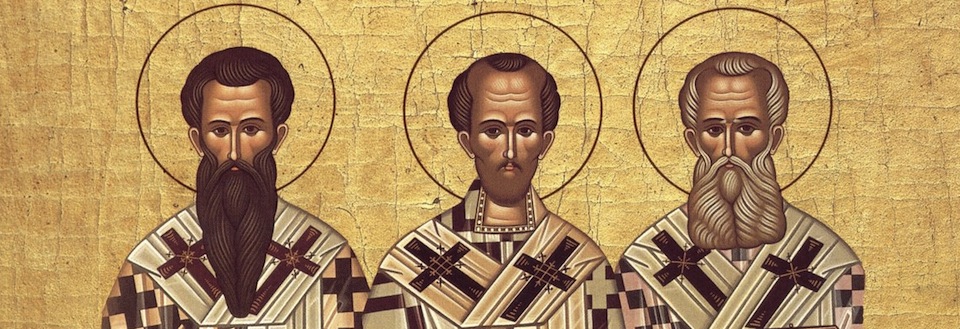
Basil of Caesarea recounting his conversion:
—“I had wasted much time on follies and spent nearly all my youth in vain labours, and devotion to the teachings of a wisdom that God had made foolish. Suddenly I awoke as out of a deep sleep. I beheld the wonderful light of the gospel truth, and I recognised the nothingness of the wisdom of the princes of this world. I shed a flood of tears over my wretched life, and I prayed for a guide who might form in me the principles of piety.”
Thursday, May 30, 2013
God incarnate

Some brilliant comments all the way from the fourth century, courtesy of Hilary of Poitiers in Book Three of De Trinitate:
A virgin bears; her child is of God.
An infant wails; angels are heard in praise.
There are coarse swaddling clothes; God is being worshipped.
The glory of his majesty is not forfeited when he assumes the lowliness of flesh.
He who upholds the universe, within whom and through whom are all things, was brought forth by common childbirth;
He at whose voice Archangels and Angels tremble, and heaven and earth and all the elements of this world are melted, was heard in childish wailing.On understanding the eternal relationship between the Father and Son he says:
The Invisible and Incomprehensible, whom sight and feeling and touch cannot gauge, was wrapped in a cradle...He by whom man was made had nothing to gain by becoming man; it was to our gain that God was incarnate and dwelt among us.
...the proper service of faith is to grasp and confess the truth that it is incompetent to comprehend its Object.
If anyone lays upon his personal incapacity his failure to solve the mystery, in spite of the certainty that Father and Son stand to each other in those relations, he will be still more pained at the ignorance to which I confess.
I, too, am in the dark, yet I ask no questions. I look for comfort in the fact that Archangels share my ignorance, that Angels have not heard the explanation, and worlds do not contain it, that no prophet has espied it and no Apostle sought for it, that the Son himself has not revealed it.
Subscribe to:
Posts (Atom)