Saturday, September 11, 2010

A holy and good God has covered us with a dark cloud


On 3rd April 1758 Sarah Edwards wrote the following words to her daughter Esther to break the news of the death of her husband Jonathan:

What shall I say: A holy and good God has covered us with a dark cloud. O that we may kiss the rod, and lay our hands on our mouths! The Lord has done it. He has made me adore his goodness that we had him so long. But my God lives; and he has my heart. O what a legacy my husband, and your father, has left to us! We are all given to God: and there I am and love to be.

It is clear that she knew the deep resources of a truly God-centred view of suffering, grief, and providence.

This is the same kind of Scriptural realism and comfort that you find in the Heidelberg Catechism. It boldly proclaims, on the basis of the Word of God, that our God is sovereign and good, being both Almighty God and a Faithful Father. Moreover "all things come not by chance, but by His fatherly hand" (HC 27).

There is much of God's goodness that we take for granted, much of his kindness that we respond to as if were the only proof of his providential rule. But his sovereign rule and providence are much greater than that.

In the book of Ruth we see God's providence on the macro and micro levels.
  • The harvest happens according to his will, "the LORD had visited his people and given them food" (1:6).
  • The birth of Obed too is under his sovereign will, "the LORD gave her [Ruth] conception, and she bore a son" (4:13)
Even the seemingly chance occurrence of Ruth being in the right field at the right time, what is delightfully referred to in chapter two as "she happened to come to the part of the field belonging to Boaz" (2:3), is also under God's providential guidance.

Yet there are also dark providences. Death, the grave, an uncertain future, bitterness, are all realities in the narrative. There would be no happy ending without these times of pain and sorrow. It is Naomi who gives voice to this sense of anguish, the hopelessness of the hand of the Lord being against her (1:13). She has felt deep wounds. And yet she still acknowledges that her God is sovereign (1:21).

From the vantage point of the end of the book it is clear that these mundane events have served the greater purpose of being part of that story of King David's history (4:17-22). Unknown to all the dramatis personae caught up in the sorrows and joys (1:13, 19-21; 4:14-16) is this greater divine purpose hidden from their view, but strong and sure and real and good and true.

There is, of course, an even greater vantage point from which to survey the struggles of life in the book of Ruth. As the first page of the New Testament is turned we see that God's purpose through this family, and this line, was to bring to realisation the coming of his Son into the world.
And Boaz the father of Obed by Ruth, and Obed the father of Jesse, and Jesse the father of David the king...and Jacob the father of Joseph the husband of Mary, of whom Jesus was born, who is called Christ. So all the generations from Abraham to David were fourteen generations, and from David to the deportation to Babylon fourteen generations, and from the deportation to Babylon to the Christ fourteen generations. (1:5-6, 16-17)
There were great purposes of grace at work even during days of dark providences. There was a mighty hand guiding all events according to the counsel of God even when the coming of Christ appeared to hang by a thread, and rested on the turn of a conversation (1:7-17).

What should this evoke from us?
  • Deep and heartfelt thanks for the outworking of God's gracious sovereign plan in history that culminated in the incarnation.
  • Confidence in our covenant God and his providence.
In the words of Heidelberg Catechism 28:
What does it profit us to know that God created, and by His providence upholds, all things?
That we may be patient in adversity, thankful in prosperity, and for what is future have good confidence in our faithful God and Father, that no creature shall separate us from His love, since all creatures are so in His hand, that without His will they cannot so much as move.

Thursday, September 09, 2010

By the mere mercy of God


 This Sunday evening I will be starting a series on the life of Abraham.  Here are some tremendous words from Calvin on the sheer grace of God lavished upon Abram the pagan idolater from Ur of the Chaldeans:
This calling of Abram is a signal instance of the gratuitous mercy of God.  Had Abram been beforehand with God by any merit of works?  Had Abram come to him, or conciliated his favour?  Nay, we must ever recall to mind that he was plunged in the filth of idolatry; and God freely stretches forth his hand to bring back the wanderer.  He deigns to open his sacred mouth, that he may show to one, deceived by Satan's wiles, the way of salvation.


But this is done designedly, in order that the manifestation of the grace of God might become the more conspicuous in his person.  For he is an example of the vocation of us all; for in him we perceive, that, by the mere mercy of God, those things that are not are raised from nothing, in order that they may begin to be something.
John Calvin, Genesis, (Banner of Truth), p. 343

Tuesday, September 07, 2010

Christ the Redeemer and progressive revelation


After a summer break during which I grew a beard, was subsequently called rabbi, read some books, and got a tan which faded immediately during a trip to Scotland, it is high time that I returned to blogging.

Sometimes it is easy to miss things in the Bible because we don't read the text closely enough.  Sometimes it is easy to miss things in the Bible because we assume that they are not to be found in the part that we are looking at.  Take Genesis and Exodus for example.

In Genesis 21:17-18 the Angel of God calls from heaven and tells Hagar that God has heard the voice of the boy.  Then the angel of God says that he will make him a great nation.  This is the very thing that God had told him that he would do for Ishmael in 21:13.  The angel of God and God have made the same promise concerning the same boy (cf. Joshua 24:2-6 with Judges 2:1).

In Genesis 22:11-12 the Angel of the LORD calls from heaven  and says that he now knows that Abraham fears God "seeing you have not witheld your son, your only son, from me."  Abraham has not witheld his only son from the Angel of the LORD.

In Genesis 22:15-18 the Angel of the LORD calls to Abraham a second time from heaven and says:
By myself I have sworn, declares the LORD, because you have done this and have not withheld your son, your only son, I will surely bless you, and I will surely multiply your offspring as the stars of heaven and as the sand that is on the seashore. And your offspring shall possess the gate of his enemies, and in your offspring shall all the nations of the earth be blessed, because you have obeyed my voice.
Is the Angel of the LORD a mere siphon, the conveyer of a tape recorded message, or is he what he appears to be, the covenant promise-maker as well as the sacrifice-receiver?  It would be very easy to approach these texts in a wooden way that, in effect, flattens out the contours of God's revelation of himself.

Lest you think that this is some quirky theory that I have dreamed up consider the words of the great Jonathan Edwards (1703-1758) on Exodus 3:
This redemption was by Jesus Christ, as is evident from this, that it was wrought by him that appeared to Moses in the bush; for that was the person that sent Moses to redeem the people.  But that was Christ, as is evident, because he is called 'the angel of the LORD' (Exodus 3:2).
Jonathan Edwards, A History of the Work of Redemption, (Banner of Truth, 2003), p. 72

The one who appears and speaks to Moses, whose presence makes the ground holy, is the Angel of the LORD.  When he speaks he says that he is the God of Abraham, Isaac, and Jacob, the covenant promise-maker and sacrifice-receiver. 

Exodus 3:2 reads, "And the angel of the LORD appeared to him in a flame of fire out of the midst of a bush."  In Deuteronomy 33:13 ff. Moses invokes the blessing of the LORD upon Joseph and "the favour of him who dwells in the bush."

It is somewhat ironic that the championing of progressive revelation has gone hand in hand with a diminished confidence in the revelation of Christ in the Old Testament.  Historically it is as if the church has regressed and not progressed in her confidence that it was "Jesus, who saved a people out of the land of Egypt" (Jude 5, ESV).

Friday, August 06, 2010

Thursday, August 05, 2010

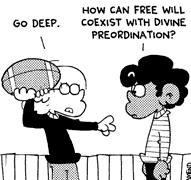
Free Will


The greatest and sweetest liberty is, 
when we have no liberty to sin at all,
when we cannot sin.

Richard Sibbes

Wednesday, August 04, 2010

Stripping God of his deity


Exhaustive foreknowledge of all future events is a perfection in God.  To deny it as the Socinians and open theists have done does not advance our understanding of God but destroys it.

Augustine said, that "to confess that God exists, and at the same time to deny that he has foreknowledge of future things, is the most manifest folly...For one who is not prescient of all future things is not God."

The Puritan Stephen Charnock, in evaluating the implications of the denial of God's exhaustive foreknowledge of the future free acts of his creatures, and underlining Augustine's remarks, said that in the book of Isaiah “God submits the being of his deity to this trial” and that “If God foreknows not the secret motions of man's will, how can he foretell them? If we strip him of the perfection of prescience, why should we believe a word of Scripture predictions? All the credit of the word of God is torn up by the roots.”

Tuesday, July 27, 2010

Van Gogh, 120 years on

Thursday 29th July marks the 120th anniversary of the death of Vincent Van Gogh


Thursday, July 22, 2010

Monday, July 19, 2010

What does God know? Augustine vs. Cicero on God's exhaustive foreknowledge


My thanks to Paul Helm for pointing me this section on God's exhaustive foreknowledge in Augustine's City of God (Book Five, Chapter Nine, "Concerning the foreknowledge of God and the free will of man, in opposition to the definition of Cicero")
To confess that God exists, and at the same time to deny that He has foreknowledge of future things, is the most manifest folly

What is it, then, that Cicero feared in the prescience of future things?  Doubtless it was this,—that if all future things have been foreknown, they will happen in the order in which they have been foreknown; and if they come to pass in this order, there is a certain order of things foreknown by God; and if a certain order of things, then a certain order of causes, for nothing can happen which is not preceded by some efficient cause.  

But if there is a certain order of causes according to which everything happens which does happen, then by fate, says he, all things happen which do happen.  But if this be so, then is there nothing in our own power, and there is no such thing as freedom of will; and if we grant that, says he, the whole economy of human life is subverted.  

In vain are laws enacted.  In vain are reproaches, praises, chidings, exhortations had recourse to; and there is no justice whatever in the appointment of rewards for the good, and punishments for the wicked.  And that consequences so disgraceful, and absurd, and pernicious to humanity may not follow, Cicero chooses to reject the foreknowledge of future things, and shuts up the religious mind to this alternative, to make choice between two things, either that something is in our own power, or that there is foreknowledge,—both of which cannot be true; but if the one is affirmed, the other is thereby denied.  

He therefore, like a truly great and wise man, and one who consulted very much and very skillfully for the good of humanity, of those two chose the freedom of the will, to confirm which he denied the foreknowledge of future things; and thus, wishing to make men free he makes them sacrilegious.  But the religious mind chooses both, confesses both, and maintains both by the faith of piety. 


Now, against the sacrilegious and impious darings of reason, we assert both that God knows all things before they come to pass, and that we do by our free will whatsoever we know and feel to be done by us only because we will it.  But that all things come to pass by fate, we do not say; nay we affirm that nothing comes to pass by fate; for we demonstrate that the name of fate, as it is wont to be used by those who speak of fate, meaning thereby the position of the stars at the time of each one’s conception or birth, is an unmeaning word, for astrology itself is a delusion.  But an order of causes in which the highest efficiency is attributed to the will of God...

Cicero, then, contends with those who call this order of causes fatal, or rather designate this order itself by the name of fate; to which we have an abhorrence, especially on account of the word, which men have become accustomed to understand as meaning what is not true.  But, whereas he denies that the order of all causes is most certain, and perfectly clear to the prescience of God, we detest his opinion more than the Stoics do.  
For he either denies that God exists,—which, indeed, in an assumed personage, he has labored to do, in his book De Natura Deorum,—or if he confesses that He exists, but denies that He is prescient of future things, what is that but just “the fool saying in his heart there is no God?”  For one who is not prescient of all future things is not God.

Saturday, July 17, 2010

The Alice in Wonderland effect


A fascinating observation in today's Guardian:

"...there's an Alice in Wonderland effect on the internet, where a person taken out of his or her context can take on epic proportions in an unfamiliar landscape, usually not in a good way. When physical space is collapsed, people can find themselves a long way from home.


The main point is Morrissey's: the devil will find work for idle hands. There's nothing idler than people on the internet, wanting nothing in particular, just wanting to be nearer the centre of things."

Friday, July 16, 2010

Don't judge the Judge


This post is taken from the series of meditations I have contributed this week at the Reformation 21 Reading with M'Cheyne Blog.  It is in fact from yesterday, and offers some reflections on Matthew 25.

If you have ever watched the auditions stage of American Idol you will have noticed that people without any recognizable vocal talents can become quite agitated with the panel of judges in general, and with Mr. Simon Cowell in particular. Even though they are their to be assessed on the quality of their performance, when the verdict is unfavorable, they think that they have the right to judge the judges.

It is so easy to bring something of that mind-set with us when we are confronted by the hard edged, non-negotiable teaching of Jesus about the day of judgement and endless future punishment for the unrepentant in hell. Our first business is to listen carefully in full recognition that Christ has the right to judge, and we, as sinners, have not been invited to debate what the appropriate punishment for sin is.

We will never come to terms with the doctrine of hell until we realize that the Son of Man is seated upon a judgement throne in his glory (25:31).

Hell is a subject that should fill us with “traumatic awe” (to borrow a phrase from J. I. Packer). Consider the words of Jesus in this chapter. Jesus speaks of exclusion, “the door was shut” (25:10), of the “outer darkness” (25:30). This state of exclusion is marked by anguish and regret, there will be “weeping and gnashing of teeth” (25:30).

This exclusion will be because there has been a separation of the sheep and the goats. Those on his right will inherit the kingdom (25:34), those on his left will depart to the eternal fire (25:41). The sheep are the blessed, beneficiaries of grace (25:34), the goats are under the curse, and will bear the just punishment of their sins (25:41).

The tangible evidence that the sheep really were sheep all along, Jesus says, is found in their attitude to “the least of these my brothers.” In other words the care shown not to the poor in general but to suffering believers, was all along done to the Lord who has identified himself with his people (25:35-36).

A large part of the traumatic awe that comes from contemplating hell is its finality and eternality. Hell is forever. The solemn words of Jesus set in parallel the destinies of the sheep and the goats:

“Then he will say to those on his left, 'Depart from me, you cursed, into the eternal fire prepared for the devil and his angels. ...And these will go away into eternal punishment, but the righteous into eternal life.” (25:41, 46)

This age will end, the age to come will not. Jonathan Edwards said that the wicked will wear out the sun in their agony and be no closer in the end.

On 22nd October 1939 C. S. Lewis preached to a group of Oxford undergraduates pre-occupied and distressed because of the war. He told them that being at university must have felt like fiddling whilst Rome was burning. But he said the real tragedy was not that Nero fiddled while Rome burned but that Nero fiddled on the brink of hell.

It is easy to be so pre-occupied with the here and now that we have no sense that we are creatures of time heading for an endless eternity.

Arminian Bible Bits and Breaking the Dress Code


Hats off to Eddie Eddings

(HT: Lewis Allen)

Gabriel's Oboe


Sublime performances of Ennio Morricone's "Gabriel's Oboe" and "The Falls" by the cellist Yo Yo Ma

The Word of God matters


Last year I had the great privilege of speaking at the Lakeland Bible School, held at the Keswick Convention Centre. 

Some of those sessions have ended up on the Gospel Coalition site, and you can listen to the session on 2 Timothy 3:14-17 "The Word of God matters" here

Thursday, July 15, 2010

A script written in eternity


This is my entry for Friday 16th July at the M'Cheyne Daily Readings Blog over at Reformation 21

Matthew 26 is a chapter full of drama.

It contains the dark betrayal of Christ by Judas Iscariot, the insidious evil plotting of the chief priests and elders, and the agonising act of denial committed by the loyalty swearing Peter.

These dramatic moments are far from haphazard intrusions that divert the course of the narrative from its otherwise intended outcome. Each event, the plot, the betrayal, the denial, is woven indelibly into the very fabric of the gospel by the hand and counsel of God (26:24). Jesus himself knows that this is his Father's will (24:42).

Far from being at the mercy of the actions of others the chapter is filled with references by Jesus to his coming death. He says that he “after two days the Passover is coming” and that he, the Son of Man, will be “delivered up to be crucified” (26:2). What is astonishing about these words is not merely their Old Testament background, Daniel's vision of the heavenly Son of Man approaching the Ancient of Days, and coming with the clouds of heaven – the very insignia of deity – but also the fact that vision of the Son of Man seated as King and Judge on the last day has just been impressed on the minds of the Twelve (25:31).

The anointing of the Lord with the expensive jar of perfume has been done, says Jesus, to “prepare him for burial” (26:12). We already know that this will be an imminent event, but the words are accompanied by this symbolic act, the sweet perfume intended to mask the smell of death.

The meal that Jesus celebrates with his disciples marks out the death of Jesus as the covenant in his blood, poured out for the forgiveness of sins (26:27-28). The effective application of the benefits of his death to his people, providing for them free and full forgiveness and cleansing, has come at the terrible cost of his own violent death. Indeed the death he will die will be an accursed one, for he will stand in the place of sinners and drink down the cup of wrath that they should drink (26:39; Psalm 75:8; Isa. 51:17; Jer. 25:15-16).

In addition to the words of Jesus about the certainty of his death, the certainty of Judas' betrayal, and the certainty of Peter's denial, we are confronted with the decree of God that these things must take place. Indeed, there are several occasions in the chapter where, breaking through the surface of the text, is the underlying bedrock of Old Testament predictive prophecy.

Jesus is the good shepherd of Zechariah's prophecy sold for thirty pieces of silver. In Zechariah 11 the good shepherd has not only been opposed by worthless shepherds, he has also been despised and rejected by the flock (Zech. 11:7-13).

There is worse to come. The very falling away of the disciples will be in direct fulfilment of the decree of God in Zechariah 13:7. “It is written” that God will strike the shepherd and the sheep will be scattered. We are confronted here not only with the certainty of the crucifixion, but also with the stark reality of its origin. God will strike the shepherd. The one spoken of by God in Zechariah 13:7 as “my shepherd” and “the man who stands next to me.” Why will God do this? How can it be right? Why is it necessary? The only cogent answer is that Jesus the sinless one will become the penalty bearing substitute, and although he is loved as a Son, he will be condemned as a sin-bearer.

Quite simply, the script for the betrayal, arrest, trial, sentencing, flogging, crucifixion and death of Jesus has not been penned by a renegade disciple, an acquiescent Roman governor and sin-hardened high priests, it has been written by the Triune God in the counsels of eternity.

In a chapter full of drama, rich with Old Testament quotations and allusions, and where the note of events unfolding according to the definite plan and foreknowledge of God is sounded again and again, we should not miss the reference to the Passover in verse two. The only fitting response now is to cry “Worthy are you to take the scroll and to open its seals, for you were slain, and by your blood you ransomed people for God from every tribe and language and people and nation, and you have made them a kingdom and priests to our God, and they shall reign on the earth...Worthy is the Lamb who was slain, to receive power and wealth and wisdom and might and honor and glory and blessing!” (Rev. 5:9-10, 12), as it will be world without end.

Wednesday, July 14, 2010

God, the final reference point


Van Til got it right:
If one does not make human knowledge wholly dependent upon the original self-knowledge and consequent revelation of God to man, then man will have to seek knowledge within himself as the final reference point.

Then he will seek to have an exhaustive understanding of reality.  Then he will have to hold that if he cannot attain to such exhaustive understanding of reality, he has no true knowledge of anything at all.  Either man must then know everything or he knows nothing.


The only way by which this dilemma can be indicated clearly is by making plain that the final reference point in predication is God as the self-sufficient One.
A Christian Theory of Knowledge, p. 17

Monday, July 12, 2010

Whose Son is the Christ? The Ref 21 M'Cheyne Blog


Every day this week it is my turn to contribute to the M'Cheyne Daily Readings Blog over at Reformation 21.  The first entry is a brief meditation on Jesus' question in Matthew 22, "Whose son is the Christ?"


One of the Old Testament texts that dominates the New Testament skyline is Psalm 110:1. It is the Old Testament text to which the New Testament most often alludes.

There are no fewer that twenty one references, quotations and allusions to this verse in the Gospels (Matt. 22:44; 26:64; Mark 12:36; 14:62; 16:19; Luke 20:42-43), the book of Acts (2:33-35; 5:31; 7:55-56) and the Letters (Rom. 8:34; 1 Cor. 15:25; Eph. 1:20; 2:6; Col. 3:1; Heb. 1:3, 13; 8:1; 10:12-13; 12:2; 1 Peter 3:22). There is also a possible allusion in Revelation 3:21.

In Matthew 22 this text lies at the very heart of understanding the person of Christ. In Matthew 22:15-40 Jesus has faced a number of curved balls, a series of questions prompted not by a sincere desire to know the truth but with the desire to “entangle him in his words” (22:15).

After fielding these questions Jesus asks one of his own (22:42-46):

“What do you think about the Christ? Whose son is he?” They said to him, “The son of David.” He said to them, “How is it then that David, in the Spirit, calls him Lord, saying “'The Lord said to my Lord, sit at my right hand, until I put your enemies under your feet'? If then David calls him Lord, how is he his son?” And no one was able to answer him a word.

This text is key to understanding the divine identity of Christ. There are clearly two persons referred to as Lord. David's “Lord” has been exalted to God's right hand, he occupies the place of supreme authority, seated with God on God's throne. Christ is no second Lord of lower rank but shares in his Father's sovereign rule over heaven and earth.

It should not be lost on us that the category for thinking of Christ in this way was not invented by the New Testament writers. They inherited this category for understanding the supreme Lordship and divine identity of Jesus, without modification, from Jesus himself. And in Matthew 22 Jesus makes it clear that David himself held as high a view of the Christ as it was possible to hold. Jesus is Lord. It is worth pondering that David's confession, just like ours, was as a result of the work of the Holy Spirit (1 Cor. 12:3).