Monday, September 04, 2006

The Down Grade Controversy


The following is an extract from Robert Shindler's two part article on "The Down Grade" from Sword and Trowel, April 1887. The original was published anonymously but with the full approval of C. H. Spurgeon.

"
In the case of every errant course there is always a first wrong step. If we can trace that wrong step, we may be able to avoid it and its results. Where, then, is the point of divergence from the "King's highway of truth"? What is the first step astray? Is it doubting this doctrine, or questioning that sentiment, or being sceptical as to the other article of orthodox belief? We think not. These doubts and this scepticism are the outcome of something going before.

The first step astray is a want of adequate faith in the divine inspiration of the sacred Scriptures. All the while a man bows to the authority of God's Word, he will not entertain any sentiment contrary to its teaching. "To the law and to the testimony," is his appeal concerning every doctrine. He esteems that holy Book, concerning all things, to be right, and therefore he hates every false way. But let a man question, or entertain low views of the inspiration and authority of the Bible, and he is without chart to guide him, and without anchor to hold him.

    In looking carefully over the history of the times, and the movement of the times, of which we have written briefly, this fact is apparent: that where ministers and Christian churches have held fast to the truth that the Holy Scriptures have been given by God as an authoritative and infallible rule of faith and practice, they have never wandered very seriously out of the right way. But when, on the other hand, reason has been exalted above revelation, and made the exponent of revelation, all kinds of errors and mischiefs have been the result".

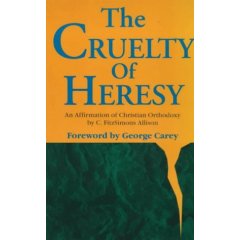
The Cruelty of Heresy


This book got me thinking seriously about the nature of heresy. I came across it in a footnote in Don Carson's The Gagging of God and then found it by accident in a book shop that seemed to specialise in the kind of material that the book warns against.

Reading about ancient heresies can be like looking at preserved specimens in glass cases. Some with strange names have died off, others have descendants who are running around today passing on the family genes. As a 17 year old starting to read theology I learned from Anthony Hoekema that the Jehovah's Witnesses who knocked on my door were serving up the same Jesus that Arius preached in the 4th century.

The Cruelty of Heresy stirred me to think about the pastoral nature and effects of heresy.

Here are some extracts from the Introduction:

"We are susceptible to heretical teachings because, in one form or another, they nurture and reflect the way we would have it be rather then the way God has provided...heresies pander to the most unworthy tendencies of the human heart. It is astonishing how little attention has been given to these two aspects of heresy: its cruelty and its pandering to sin". p. 17

"It is now almost shameful to call oneself 'orthodox', while the label 'heretic' is worn as a badge". p. 18

"Cynics who have relinquished any search for truth have claimed that 'orthodoxy' is what we believe, as heresy is what others believe". p. 19

"Successful heretics soon claim their opinion to be 'orthodox'". p. 19

"...we do not lack objective standards to which we can appeal when we disagree about whose doctrine is 'correct'". p. 19

"If a teaching is wrong opinion rather than right opinion the consequences are cruel, the Christian faith is distorted, and people who follow these teachings are hurt". p. 20

"...orthodoxy, over time, seems to keep its form but lose its substance". p. 22

And one from the opening of the first chapter:

"In spite of popular ideas concerning heresies, they are, in fact, narrow and limited ways of understanding Christianity". p. 25

Sunday, September 03, 2006

Wolves in evangelical clothing


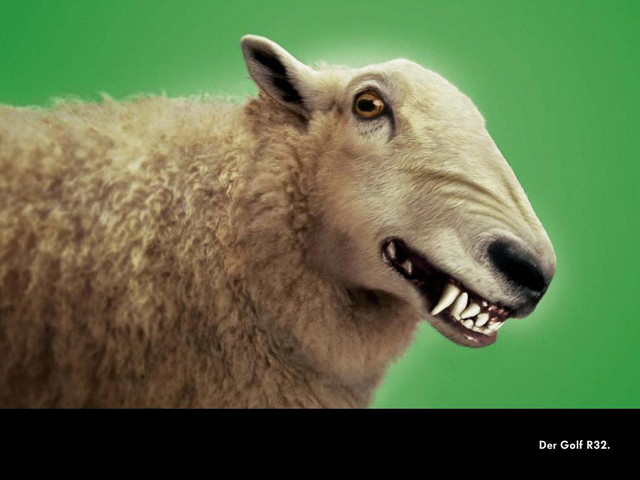
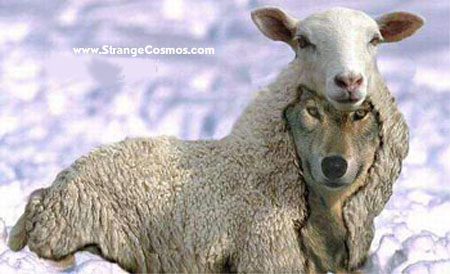
The fear of being thought negative, and associating the discernment of error with an unloving attitude, opens us up to soul destroying influences. It actually prevents us from hearing the voice of Jesus as he warns us about wolves in sheep's clothing. We cannot afford to be complacent or naive on these matters.

Church history, that long extended memory of God's dealings with his people, is full of tragedies, triumphs and warnings. Here is a warning worth listening to.

"I dare boldly say, that if ever he [Satan] settle to a stated opposition to the gospel it will be in Socinianism" (John Owen, Vindiciae Evangelicae, p. 53)

Socinianism brought together a pelagian view of human nature, the denial of God's exhaustive foreknowledge (what we know today as open theism), the denial of the Trinity, the denial of eternal punishment, and the denial of penal substitutionary atonement.

Several of these views are in the process of taking up residence in evangelicalism as members of the household. Obviously the Trinity is not being questioned, well not just yet.

Which leads on to a conundrum. Why would anyone identify themselves as evangelical when historically their position is in fact an attack on evangelical distinctives? It makes much more sense to call yourself what you are instead of what you are not.

One can only conclude that there is a benefit in doing so. When teachers change their views and no longer preach what they once did, and when those changes have moved them away from evangelical theology, it is a matter of honesty to give up the name. What seems to happen is that instead of a turning away from evangelicalism there is a turning upon evangelical theology. It is the best representatives of the heritage who are then treated as aberrants instead of the current defectors.

But giving up the name would mean giving up the funds, the public profile, the book contracts, the salary, the home, the conference invitations, the professorship, the pension, the pastorate etc. In terms of this world there is a cost to honest dealings. But then heresy has always been a moral matter as well as an intellectual one. Since 1945 evangelicalism has been a surprise success story. And that success, in terms of numbers and influence, is hard to give up on.

When confronted over errors (in the specific case I have in mind an attack on the atonement) I have heard someone reply that in fact their view is the gospel. But that gospel was not the gospel which, by their own admission, they used to preach. Doubtless it was a sincerely meant statement. But what is morally questionable is the failure to move on to another constituency altogether. Evangelicalism's low doctrinal immune system makes it an inviting host for "different" theologies to thrive on.

In fairness to the Socinianians, as anti gospel as they undoubtedly were, many of them did suffer in the 17th century for their convictions. And in fairness to John Owen he made it crystal clear that behind the "woolly" talk of believing only "what the Bible taught" there was a pelt and a mouth with sharp teeth. Socinianism is "another gospel". The fact that key elements of it are being passed off as viable 21st centuy options for evangelicals won't turn wolves into sheep.


Saturday, September 02, 2006

He has been a liar from the beginning

And heresies are his lies against the truth. Here is another example of the older perception of dangerous theological error being attributable to the work of the devil. How did Cyprian know this? Because he read his Bible.


"It is not persecution alone that we ought to fear, nor those forces that in open warfare range abroad to overthrow and defeat the servants of God. It is easy enough to be on one's guard when the danger is obvious...

There is more need to fear and beware of the Enemy when he creeps up secretly, when he beguiles us by a show of peace and steals forward by those hidden approaches which have earned him the name of the 'Serpent'...He invented heresies and schisms so as to undermine the faith, to corrupt the truth, to sunder our unity
.

Those whom he failed to keep in the blindness of their old ways he beguiles, and leads them up a new road of illusion".

Cyprian of Carthage

Heresy “connotes doctrinal deviation from the fundamental truths taught in Scripture and the orthodox Christian church, and active propagation of the same”

Bruce Demarest

New Dictionary of Theology (ed. Sinclair B. Ferguson, David F. Wright, and J. I. Packer; IVP, 1988)

Friday, September 01, 2006

The Tragedy of Heresy is the Corruption of the Gospel


"The primary danger of heresy, however, is not the theft of institutions, communities, and traditions, but the corruption of the church's proclamation"

John Leith, Crisis in the Church, p. 35

Thursday, August 31, 2006

Modernism for Christianity: the not so great exchange


"The crucial ingredient, then, in the mix that produced an enduring unbelief was the choice of believers. More precisely, unbelief resulted from the decisions that influential church leaders--lay writers, theologians, ministers--made about how to confront the modern pressures upon religious belief. Not all of their selections resulted from long thought and careful reflection; part of our humanity, after all, is that we have much in common with lemmings. But they were choices. And the choices, taken together, boiled down to the decision to deal with modernity by embracing it--to defuse modern threats to the traditional bases of belief by bringing God into line with modernity".

James Turner, Without God, Without Creed, p. 266-7

Wednesday, August 30, 2006

Taking false teaching with apostolic seriousness


"After reading such verses [2 Peter 2:1; Jude 3-4], we might wonder if any of us have the same kind of heart for purity of doctrine in our Christian organisations, and the same sort of sober apprehension of the destructiveness of false doctrine, that the New Testament apostles had in their hearts. If we ever begin to doubt that false teaching is harmful to the church, or if we begin to become complacent about false doctrine, thinking that it is fascinating to ponder, stimulating to our thoughts, and worthwhile for discussion, then we should remind ourselves that in several cases the New Testament specifies that the ultimate source of many false teachings is Satan and his demons".

Wayne Grudem, "Why, When, and for What Should We Draw New Boundaries?", in Beyond the Bounds, p. 342

Dealing with Polemical Blind spots


One of the things that you are taught on your first driving lesson is that there is a blindspot over your right shoulder. No matter how much you check your mirrors there is an area that you cannot see. Ignorance of that blindspot has the potential for causing accidents. It is like that with sin. We can deceive ourselves that our actions are acceptable in one area, and our consciences are clear, but lurking in the blindspot are thoughts, attitudes and even actions that are dishonouring to the Lord. This may well be the case in our zeal for the truth in the context of controversy. Engaging in polemics can blind us to our own sins.

That we can sin in this way should come as no surprise to us. After all there is no other situation that we experience where we are free from temptation. When engaging in controversy there are particular sins that we will face.

Before getting to the main part of the argument there are some preliminary matters to bear in mind. Those who vocalise concern over false doctrine are of course an easy target. There is a consistent, and at times quite inaccurate, typology at work in these debates. There is the stigma of being branded unloving, ungracious, narrow, harsh, and even schismatic, for defending the truth. Strong words about error are not allowed. But that is itself a narrow-minded view, far narrower than the Bible.

There has to be room for Paul's responses to the Galatian and Colossian false teachers, and Christ's words to the Pharisees and teachers of the law. I'm sure that it is possible for us to be strong on condemning error and yet to be humble at the point of assessing the reasons for our own right understanding--at the same time. Whether we are guilty of pride in our own orthodoxy is a matter to search our own hearts about. It isn't something that can be read off automatically and infallibly whenever we see someone become angry because of destructive heresies.

But although sinful attitudes are far from synonymous with condemning error they are not totally unavoidable. Consider Francis Schaeffer's description of the sins in the blindspot:

“Thus whenever it becomes necessary to draw a line in the defense of a central Christian truth it is so easy to be proud, to be hard. It is easy to be self-righteous and to self- righteously think that we are so right on this one point that anything else may be excused— this is very easy, a very easy thing to fall into. These mistakes were indeed made, and we have suffered from this and the cause of Christ has suffered from this through some fifty years.” (The Great Evangelical Disaster, p. 352).

We can examine ourselves along these lines both positively and negatively. What graces am I expected to display even when I am dealing with theological opponents? What attitudes and actions am I to avoid when dealing with perceived error? Paul takes this two-fold approach in 2 Timothy 2:23-26 (ESV):

23 Have nothing to do with foolish, ignorant controversies; you know that they breed quarrels. 24 And the Lord's servant must not be quarrelsome but kind to everyone, able to teach, patiently enduring evil, 25 correcting his opponents with gentleness. God may perhaps grant them repentance leading to a knowledge of the truth, 26 and they may escape from the snare of the devil, after being captured by him to do his will.

Opponents of the gospel are in a desperate spiritual situation. Is there any hope for them? Maybe the Lord will grant them repentance so that they will come to know and believe the truth. Until, or unless, that happens they are ensnared by the devil. Failure to think in these categories seems to be the cause of the ungodliness that can exist on the part of the defender of the gospel. Right belief of the gospel, true saving faith, is a work of grace. There is no room here for pride in our rightness but thankfulness. Who, after all, has made us to differ? What do we have that we did not receive? Patience, gentleness, kindness, and a refusal to be quarrelsome are the fruit of consciously knowing that there is a great spiritual battle going on. John Newton provided solid counsel from Paul's words here:

If, indeed, they who differ from us have a power of changing themselves, if they can open their own eyes, and soften their own hearts, then we might with less inconsistency be offended at their obstinacy; but if we believe the very contrary to this, our part is not to strive, but in meekness to instruct those who oppose”.

They are culpable since they have chosen to embrace error, but they are also deceived. Now, what else but knowing that a change of heart is something solely God given can temper the approach of the polemicist? What other explanation is there for patience and gentleness as appropriate dispositions? Coming to a knowledge of the truth has never been self-generated. Calvin wrote that “when we remember that repentance is God's gift and work, we shall hope the more earnestly and, encouraged by this assurance, will give more labour and care to the instruction of rebels”. Such gentleness and patience should not be confused with moral weakness and softness. Paul's words here are consistent with those written to Titus on silencing the false teachers, rebuking straying believers sharply, and after two warnings having nothing to do with divisive people.

Tuesday, August 29, 2006

Schaeffer on the Body Snatchers


Here is Francis Schaeffer on the recurring theme of alien worldviews using the church as a host. Hiding beneath the surface of Christian vocabulary, and coming out of the mouths of preachers and seminary professors, is unbiblical philosophy. In Schaeffer's day it was old and new forms of liberalism. See previous posts on The Invasion of the Body Snatchers:

"The real difference between liberalism and biblical Christianity is not a matter of scholarship, but a matter of presuppositions. Both the old liberalism and new liberalism operate on a set of presuppositions common to both of them, but different from those of historic, orthodox Christianity".

The Church Before the Watching World, Complete Works volume 4, p. 118

"The new theology is simply modern thought using religious words...Historic Christianity and either the old or the new liberal theology are two separate religions with nothing in common except certain terms which they use with totally different meanings".

Ibid. p. 132

"I would repeat that liberal theology is only humanism in theological terms" A Christian Manifesto, Complete Works volume 5, p. 442

If that has been the case in recent times with modernism/liberalism, and true in other eras of the Church, then shouldn't the present case for postmodernising the faith by viewed with deep suspicion? Isn't the onus on those who wish to welcome postmodernism to show that it isn't the latest move in a long tradition of subverting orthodox Christian belief?

John "The Hammer" Owen


John Owen was justly christened, writes H. J. McLachlan, a "hammer of the Socinians". In 1655 his work Vindiciae Evangelicae: or the Mystery of the Gospel vindicated and Socinianism examined was published at the request of the Council of State. Here are two quotations from the lengthy preface charting the history of Socinianism. They both indicate that heresy is a matter not merely of the head and intellect but of the heart. The choice of heresy is a spiritual and moral matter and concerns our orientation to God's Word and contentment with his verbal revelation. The first quotation touches on the cause and cure of heresy:

"This I am compelled to say, that unless the Lord, in his infinite mercy, lay an awe upon the hearts of men, to keep them in some captivity to the simplicity and mystery of the gospel who now strive every day to exceed one another in novel opinions and philosophical aprehensions of the things of God, I cannot but fear that this soul-destroying abomination will one day break in as a flood upon us."

And in the second Owen sets this in a broader framework of the causes of heresy:

"Not to speak of the general and more remote causes of these and all other soul-destroying errors, or the darkness, pride, corruption and wilfulness of men; the craft subtilty, envy and malice of Satan; the just revenging hand of God, giving men up to a spirit of delusion, that they might believe lies, because they delighted not in the truth".

Owen's work is a massive exegetical and theological defense of the gospel. In the end it is the Scriptures that are the court of appeal and the arena where he refuted the Socinians. In that regard Owen held that knowledge of the original langauges was needed to stop his opponents escaping and evading his counter-arguments.


Sunday, August 27, 2006

Gresham Machen on polemics


"...a large part of the New Testament is polemic; the enunciation of evangelical truth was occasioned by the errors which had arisen in the churches...At the present time, when the opponents of the gospel are almost in control of our churches, the slightest avoidance of the defense of the gospel is just sheer unfaithfulness to the Lord. There have been previous great crises in the history of the Church, crises almost comparable to this. One appeared in the second century, when the very life of Christendom was threatened by the Gnostics. Another came in the Middle Ages when the gospel of God's grace seemed forgotten. In such times of crisis, God has always saved the Church. But he has always saved it not by theological pacifists, but by sturdy contenders for the truth".

J. Gresham Machen, Christianity & Liberalism, p. 174

"Heresy always affects morality, if it's heretical enough"

G. K. Chesterton

Friday, August 25, 2006

The Fatal Attraction of Heresy


One of the deeply perplexing things about heresy is its appeal. Who, in their right mind, would want to believe what is false?


Perhaps we can make allowance for those who believe a heresy because they are sincerely ignorant about the truth. After all imagine reading a version of the Bible that deliberately misinterprets and misrepresents the full deity of Jesus Christ and the deity and personality of the Holy Spirit. Then add to that the environment of being taught error by zealous, well meaning people.

But such allowances are no help toward a comprehensive explanation. There are people who deliberately choose not to believe the truth, and instead openly choose to embrace error. What accounts for this wilful behaviour?

There are two interconnected parts to the appeal factor of heresy:

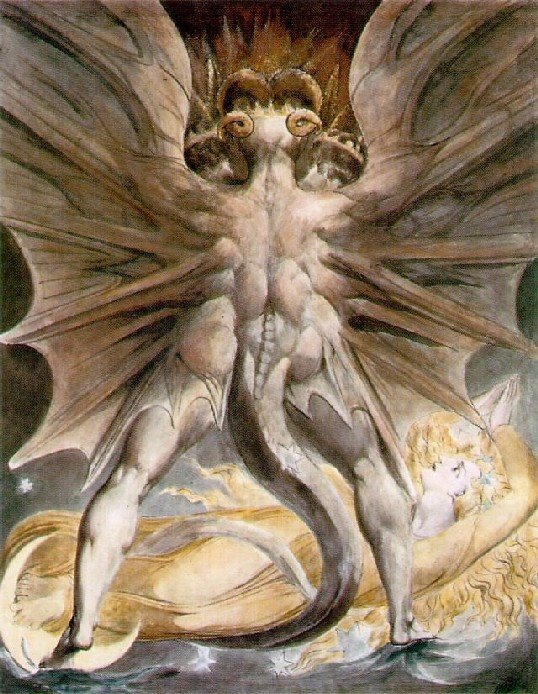
1. A biblical theology of heresy understands that destructive error ultimately originates with Satan. Paul in 2 Corinthians 11 unmasks the super-apostles. They are really servants of Satan, even though they masquerade as servants of Christ. And Paul likens their approach to the Serpent deceiving Eve by his cunning. The Corinthians are being lead astray from a pure devotion to Christ. Having abandoned the faith, Paul writes to Timothy, some will follow deceiving spirits and things taught by demons. Timothy must gently instruct his opponents knowing that they are in the trap of the devil.

Incidentally John Owen viewed the rise of anti-trinitarianism during the Reformation as a change of strategy by Satan because of the success of Luther in recovering the gospel of justification by faith alone. One of Owen's theological opponents, the Socinian John Biddle, returned the favour. Biddle believed the Trinity to be a Satanic deception mediated through Platonic philosophy.

The origin of heresy is demonic. Behind the false teachers is the deceiving work of the ancient Serpent, the Devil. As unpalatable to the taste as it may seem this is the inescapable reality of heresy in the biblical worldview. And recognising this fact leads to the second part of understanding the appeal factor.

2. Heresy is theological disobedience with alleged benefits. It is a different perspective on the truth that promises better things than the Word of God. It is makes the "truth" easier to believe. It tells reason not to be a servant but an autonomous judge, it turns that which is incomprehensible, but revealed and accommodated to our understanding, into a flat pack that is easier to assemble.

Why else would you believe it unless it offered to deliver the goods? This is C. Fitz-Simon Allison's thesis in The Cruelty of Heresy. Heresy is the way we would like things to be, not God's way which is infinitely better. It appeals to some aspect of our sinfulness and confirms it by becoming the truth that we really want. There is something in every heresy that appeals to us, but the appeal is not to our love of goodness and truth.

This is how Irenaeus put it:

"Error, indeed, is never set forth in its naked deformity, lest, being thus exposed, it should at once be detected. But it is craftily decked out in an attractive dress, so as, by its outward form, to make it appear to the inexperienced (ridiculous as the expression may seem) more true than the truth itself".

Isn't this the way it was in the Garden? There, the truth that Satan offered was so much better than what God knew but kept from Adam & Eve. Without these inducements why else would someone turn away from the truth and embrace error? Think of heresy as a moral problem instead of it just being a neutral choice among theological options.

Thursday, August 24, 2006

The Inevitability of Deceit


Calvin on Acts 20:30

"This amplifies the grievousness of the evil, because there be some wolves within, and so hiding themselves under the title of pastors, [which] do wait for some opportunity wherein they may do hurt. Also, he declares what danger these wolves do threaten, the scattering abroad of the flock, when the Church is drawn away from the unity of faith, and is divided into sects. Neither are all those wolves who do not their duty as they ought, but there be oftentimes hirelings, a kind of men not so hurtful as the other. But the corruption of doctrine is a most deadly plague to the sheep. Now, in the third place, the fountain and beginning of this evil is noted, because they will draw disciples after them. Therefore, ambition is the mother of all heresies".

Wednesday, August 23, 2006

The Problem is really with the Truth


Why do the same old heresies keep on coming back again and again? After the work of the ecumenical councils in defining the boundaries of orthodox biblical views of Christ and the Triune nature of God you would think that the matter was settled. Not so. In century after century the same denials reappear. Even during the reformation there was a revival of anti-trinitarianism. Here is Harold O. J. Brown's explanation of persistent error:

"A still more striking indication of the fact that the doctrines of historic Christianity are based on realities and are not merely intellectual theories is offered by the persistence and recurrence of major heresies. Over and over again, in widely separated cultures, in different centuries, the same basic misunderstandings and misinterpretations of the person and work of Christ and his message reappear. The persistence of the same stimulus, so to speak, repeatedly produces the same or similar reactions" (Heresies, p. 10).

This isn't the only explanation, or the whole picture. But it does provide a good reason as to why 21st century opponents of Trinitarian belief (for example) are not that far removed from Arius in the 5th century, and why John Owen's 17th century response to Socinianism is required reading for defenders of penal substitution today.

Sunday, August 20, 2006


"Heresy lies in the sense assigned, not in the word written. The guilt is that of the expositor, not of the text"

Hilary of Poitiers

Tuesday, August 08, 2006


In confutation of false doctrines, he (the preacher) is neither to raise an old heresy from the grave, nor to mention a blasphemous opinion unnecessarily: but, if the people be in danger of an error, he is to confute it soundly, and endeavour to satisfy their judgements and consciences against all objections


Directory of Public Worship


How to Deal with Those Who Differ from Us (part 2)

Dr. Roger R. Nicole


Part 1 (continued): What Do I Owe to the Person Who Differs From Me?

"Beyond what a person says or writes, we must attempt to understand what a person means. Now it is true that there are what are called "Freudian slips," that is there are people who do not express themselves exactly the way it should be done; but in the process somehow they give an insight into a tendency that is there in them all along and which leads them to express themselves in an infelicitous but revealing manner. So it is appropriate, I suppose, to note this as a personal footnote, so to speak, in order possibly to make use of it at some time in the discussion. But if somebody fails to express himself or herself accurately, there is no great point in pressing the very language that is used. We ought to try to understand what is the meaning that this language is intended to convey. In some cases, we may provide an opportunity for an opponent to speak more accurately.

Similarly, in dealing with those who differ, we ought not to quibble about language just in order to pounce on our opponent because he or she has not used accurate wording. It is more effective to seek to apprehend what is meant and then to relate ourselves to the person's meaning. If we don't do that, of course, there is no encounter because this person speaks at one level and we are taking the language at another level; and so the two do not meet, and the result is bound to be frustrating. So if we really want to meet, we might as well try to figure out the meaning rather than to quibble on wording.

Moreover, I would suggest that we owe to people who differ from us to seek to understand their aims. What is it that they are looking for? What is it that makes them tick? What is it that they are recoiling against? What are the experiences, perhaps tragic experiences, that have steeled them into a particular stance? What are the things that they fear and the things that they yearn for? Is there not something that I fear as well or yearn for in the same way? Is there not a possibility here to find a point of contact at the very start rather than to move on with an entirely defensive or hostile mood?

As an example, it may be observed that in the fourth century Arius, and undoubtedly many of his supporters, were especially leery of modalism, a serious error in the conception of the Trinity whereby the Godhead manifested Himself in three successive forms or modes as Father, Son and the Holy Spirit rather than to exist eternally as Three Who have interpersonal relations with each other. From Arius' vantage point, the orthodox doctrine of the full deity of the Son ans the Holy Spirit did of necessity imply a modalistic view. It did not help that one of his very vocal opponents Marcellus of Ancyra did, in fact, border dangerously on modalism. Arguments designed to show the biblical and logical strengths of the doctrine of the Son's full deity or vice versa the weakness of Arius's subordinationism would not be likely to be effective unless the instinctive fear of an implied modalism were addressed and shown to be without solid foundation. With all due respect to the soundness, courage, and perseverance of those like Athanasius and Hilary who consistently resisted Arianism, one may yet wonder if a more effective method of dealing with this error might not have been to allay the fear that orthodoxy inevitably would lead to modalism".